
Bird of the Month: Sandhill Crane
The Sandhill Crane is one of North America’s most ancient and awe-inspiring birds, and April marks the final chapter of their spectacular spring migration through Colorado. If you have never stood at the edge of a field in the San Luis Valley at dawn, listening to the bugling chorus of thousands of cranes lifting into the cold morning air with the snow-capped Sangre de Cristo Mountains glowing pink behind them, it belongs on your life list. This is one of the great wildlife spectacles in the American West, and it happens right here in our backyard.
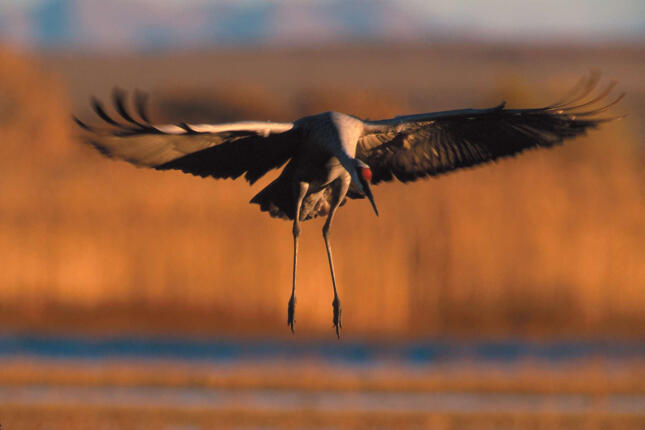
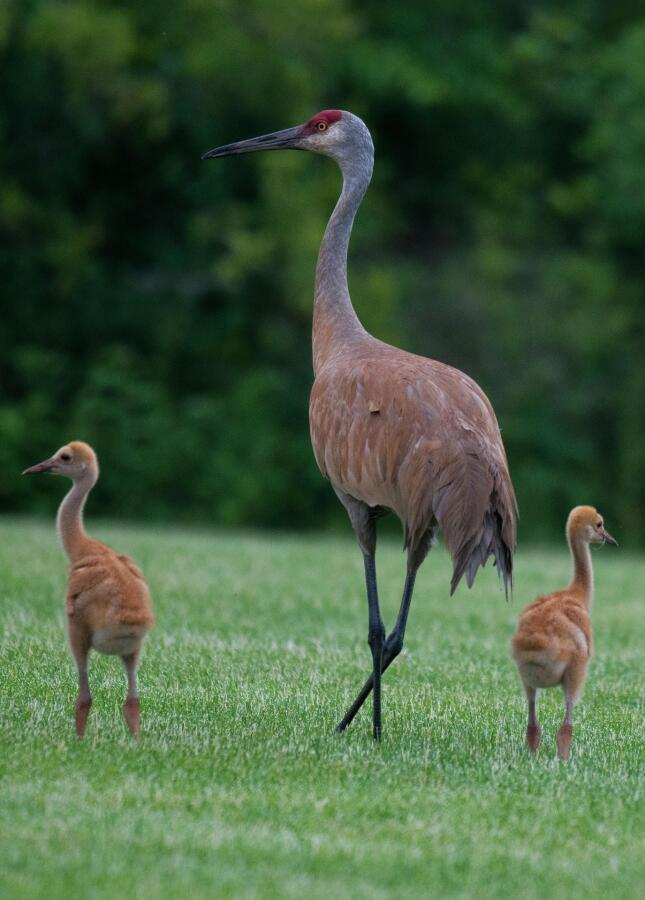
Sandhill Cranes are unmistakable birds. They stand roughly four feet tall, weigh around 11 pounds, and have a wingspan that can reach seven feet! Their plumage is a soft gray, though individuals often appear rusty reddish-brown due to a fascinating habit: cranes deliberately rub iron-rich mud into their feathers during preening, effectively staining themselves for the season. No one knows for sure why they do this, but camouflage is the most popular theory. The most distinctive feature is the vivid bare red crown on the forehead, a patch of wrinkled crimson skin that contrasts sharply with white cheeks and a long, pointed bill.
In flight, Sandhill Cranes are easy to distinguish from herons by one simple rule: cranes fly with their necks fully extended, while herons tuck their necks back into an S-curve. Their wingbeats are steady and powerful, with a characteristic flick. When thousands are aloft together, the air fills with a primordial rattling trumpet call, a sound produced by a unique windpipe that coils into the sternum like a French Horn. That call carries for miles and is utterly unlike any other bird you will hear in Colorado.
Habitat and Range
Sandhill Cranes belong to the family Gruidae, a group with fossil records dating back an estimated nine million years, making them among the oldest living bird lineages on Earth! Several subspecies exist across North America. The cranes we see in Colorado are primarily the Greater Sandhill Crane (Antigone canadensis tabida), part of what biologists call the Rocky Mountain Population. Nearly 95 percent of the entire Rocky Mountain Population migrates through Colorado’s San Luis Valley each spring and fall, making it one of the most critical stopover sites for any migratory bird species in the western United States. The valley’s combination of vast wetlands and agricultural grain fields provide exactly the fuel these birds need for the final push to their northern breeding grounds. While the San Luis Valley migration spectacle peaks in February and March, cranes typically linger into early April, with stragglers still passing through mid-month. April is also when Colorado’s resident breeding population gets to work: Sandhill Cranes nest in the wetlands and wet meadows of northwestern Colorado, particularly in Grand, Jackson, Moffat, Routt, and Rio Blanco Counties. Some nest sites in Colorado have been occupied nearly continuously for 25 to 30 years!
Food Preferences and Foraging Behavior
Sandhill Cranes are omnivores with a highly adaptable diet that changes with the season and habitat. In the San Luis Valley during spring migration, they take full advantage of the agricultural landscape, feeding heavily on leftover barley, wheat, and small potatoes remaining in harvested fields. Their stout, sturdy bill is built for this kind of work, strong enough to penetrate frozen ground, and serrated along the edges to help grip slippery prey like worms and small snakes.
When not feeding in grain fields, cranes forage in wetlands and mudflats for a wide variety of foods, including:
• Tubers and plant roots
• Seeds and waste grain
• Insects, worms, and crayfish
• Small mammals and reptiles
• Amphibians and the eggs of other birds
A key behavioral pattern worth noting: cranes spend the day foraging in fields and meadows, then fly to shallow water to roost overnight. Standing in water provides natural protection from ground predators like coyotes and foxes. Their powerful legs and sharp claws make them formidable defenders of their young on land, and they will not hesitate to face down a predator that gets too close to a nest or colt.
Courtship, Mating, and Nesting
Sandhill Cranes are famous for their elaborate courtship dances, and April is the heart of nesting season for Colorado’s breeding population. Their dancing displays are genuinely spectacular: birds leap into the air, spread their wings wide, bow deeply, pump their heads, and call loudly. The dances can involve just a bonded pair or erupt into group dancing among entire flocks, even non-breeding birds participate, as if unable to resist.
Cranes mate for life and typically do not begin breeding until they are four to five years old. Before finding a mate, young cranes travel in bachelor flocks, often returning to the general area where they were raised. Once a pair bonds, they return to the same nesting territory year after year, sometimes using the same spot for decades.
In Colorado, nest building typically begins in mid-April through mid-May, though cranes nesting at higher elevations, up to 9,000 feet, may start a month later due to persistent snowpack. Nests are impressive mound-like platforms, often four to five feet across, built from cattails, sedges, grasses, and other marsh vegetation piled up in shallow standing water. Both parents gather material and toss it over their shoulders to form the mound and the female arranges the final structure.
The female lays one to two eggs, and both parents share incubation duties over approximately 30 days, males more during the day, females primarily at night. The chicks, called colts, hatch covered in golden-yellow down and can leave the nest within a day of hatching. Both parents feed and protect the colts intensively for the first several weeks, and the family stays together through the following winter, with the juveniles finally separating from their parents just before the next breeding season begins.
Where to See Them in Colorado
For the migration spectacle, the San Luis Valley in southern Colorado is without question the premier destination, and early April gives you one last chance to catch it before the cranes move on.
• Monte Vista National Wildlife Refuge – The crown jewel of crane watching in Colorado. The refuge’s barley fields and wetlands attract enormous numbers of birds, and the 2.5-mile Wildlife Drive along Highway 15 offers some of the most accessible viewing anywhere. Observation pullouts along the highway are excellent for watching cranes at close range.
• San Luis Lakes State Wildlife Area – Near Alamosa, this large lake complex is particularly productive at dawn, when cranes gather on the north shore. Note that some wetland areas may be closed mid-February through mid-July for nesting.
• Great Sand Dunes National Park – The wetlands surrounding the dunes host hundreds of cranes during migration, with the iconic sand dunes and Sangre de Cristo Mountains providing a breathtaking backdrop.
• Alamosa National Wildlife Refuge and Rio Grande State Wildlife Area – Both worth visiting, though crane numbers are typically lower than at Monte Vista.
For Colorado’s nesting cranes, northwestern Colorado’s Yampa Valley and the broader Routt and Jackson County area offer excellent summer viewing. The best times to observe cranes anywhere are the hour around sunrise and the hour before sunset, when birds are most active and the light is most beautiful.
Conservation
The Rocky Mountain Population of Sandhill Cranes is considered stable and has grown in recent decades. Overall, Sandhill Crane populations increased at roughly four percent per year between 1966 and 2019 according to the North American Breeding Bird Survey, and Partners in Flight estimates the total breeding population at around 560,000 birds. They are currently rated as a species of low conservation concern.
That said, their dependence on specific wetland habitats makes them vulnerable to habitat loss and water management decisions. The health of the San Luis Valley’s wetlands and agricultural landscape directly determines how well this migration continues to function. Wetland conservation, responsible water use, and maintaining the agricultural practices that produce the waste grain cranes depend on during migration are all critical to their long-term future.
The Sandhill Crane is not just a bird; it is a living connection to an ancient world, a species whose lineage predates the Rocky Mountains themselves. Watching thousands of them rise together at dawn, their calls echoing across a Colorado valley, is one of those experiences that reminds you why birds matter.
Want to learn more?
Visit the Colorado Crane Conservation Coalition at coloradocranes.org, or look into the Monte Vista Crane Festival, typically held in March.